

Midwife-led care
During pregnancy, most of your contact will be with your community midwife who will see you regularly to ensure that both you and your baby are healthy and to answer any questions you may have.
As soon as you have a positive pregnancy test your GP surgery will provide you with the information you need to access the care of one of our community midwives. Please watch the video at the top of the page for more information on early pregnancy including screening tests.
Once you have received this information, you should feel able to make informed decisions about your care and where you would like to have your baby. A booking appointment is then planned to discuss these decisions and your care during your pregnancy and after you have your baby.
You will be offered two ultrasound scans at a hospital of your choice. The first scan, in early pregnancy, is to confirm the expected date of delivery and the second scan is to assess your baby’s development.
You will also be offered parent education classes and given an appointment to attend an infant feeding workshop.
Throughout your pregnancy, information and advice is available to you from all the health professionals involved in your care. We have many leaflets readily available which may help you understand, and make decisions on, your care and treatment. The information most appropriate to you will be provided to you throughout your care and you can talk to your midwife or health professional at any point for more advice.
Low-risk pregnancies do not generally require a consultant appointment, the midwife is responsible for your care. Your health, and your baby’s development will be reviewed at each appointment during your pregnancy. Additional appointments or a change to your pathway of care may be recommended if there are any concerns.
Consultant-led care
Should you require any extra care (or you are deemed higher-risk) your midwife will refer you to the hospital to see a consultant or specialist midwife.
Antenatal clinics are held in a variety of settings, including GP surgeries, children’s centres and in our hospitals to give you a choice of time and location that is most convenient for you. Your community midwife will provide you with the information you need to decide where to have your antenatal care, including those clinics run by our specialist midwives.
Women with a multiple pregnancy are cared for by a core multidisciplinary team.
It is recommended that women with multiple pregnancies have increased monitoring and we will offer you additional appointments and scans.
Some women already have high blood pressure (hypertension) before they become pregnant and they may be on treatment for this. You can also develop high blood pressure whilst you are pregnant, which returns to normal after your baby is born. This is called gestational hypertension.
There is a separate, less common condition called pre-eclampsia which can develop during pregnancy. This involves high blood pressure as well as other symptoms. This condition can become serious and needs extra care.
If you have any problems with your blood pressure, either before pregnancy or which develop during pregnancy, we will offer you additional monitoring and appointments with the multidisciplinary team.
We also have the option of home blood pressure monitoring, which will be discussed with you at your appointments.
Pre-existing diabetes
Patients with pre-existing diabetes will receive care from a team of specialist midwives and consultants. An individual management plan will be developed with the patient and the specialist team, including antenatal care, labour care and a postnatal care plan.
Most pregnant women with diabetes will go on to have a healthy baby, but there are some possible complications you should be aware of.
If you have type 1 or type 2 diabetes, you may be at higher risk of having:
- a large baby – which increases the risk of a difficult birth, having your labour induced or needing a caesarean section
- a miscarriage
People with diabetes are at risk of developing problems with their eyes (diabetic retinopathy) and kidneys (diabetic nephropathy).
Some people with type 1 diabetes can develop diabetic ketoacidosis, where harmful chemicals called ketones build up in the blood.
Pregnancy can increase your risk of developing these problems or make existing ones worse.
The best way to reduce the risks to you and your baby is to ensure your diabetes is well controlled before you become pregnant. Before you start trying for a baby, ask your GP or diabetes specialist for advice. You should be referred to a diabetic pre-conception clinic for support.
Gestational diabetes (GDM)
Gestational diabetes is high blood sugar (glucose) that develops during pregnancy and usually disappears after giving birth. It can happen at any stage of pregnancy, but is more common in the second or third trimester.
It happens when your body cannot produce enough insulin – a hormone that helps control blood sugar levels – to meet your extra needs in pregnancy.
Gestational diabetes can cause problems for you and your baby during pregnancy and after birth. But the risks can be reduced if the condition is detected early and well managed.
If you are diagnosed with GDM in your pregnancy, you will receive care from a team of specialist midwives and consultants. An individual management plan will be developed with you, including antenatal care, labour care and a postnatal care plan.
For more information, see Diabetes UK's information here.
Your midwife will calculate your BMI at your booking appointment and advise you accordingly. Patients with a BMI over 35 receive care from a specialist team of midwives and consultants. You may also receive an assessment from an anaesthetist if your BMI is very high.
Having a high BMI when pregnant may increase the risk of pregnancy and birth complications and can have an effect on your unborn baby.
There are lots of services which can help you be physically active and eat well during your pregnancy and develop healthier habits for life. Your midwife can refer you to these services at your booking appointment or any stage in pregnancy.
If you live in Northumberland, your midwife will refer you to a ‘Health Trainer’ who will work with you to develop a personalised well being plan to promote a healthy pregnancy. Health Trainers are specially trained to support you to achieve your personal goals and to have a healthier pregnancy.
If you live in North Tyneside, your midwife will refer you to a Health Coach, who are trained to support you to make healthier choices to improve your wellbeing. The Health Coach can refer you on to other services such as Active North Tyneside specialist classes and support.
We work closely with our colleagues in Physiotherapy and Health Psychology to support women with a high BMI, a referral into these services may be discussed with you.
More information about having a healthier pregnancy here.
At your booking appointment, you will be assessed for a variety of risk factors, including those that would make you at higher risk of preterm birth (less than 37 weeks gestation). If you are identified as being at risk, you will receive additional care from our specialist pre-term birth clinic.
An individual care plan will be developed with you in consultation with the specialist team.
Take a look at the short video below about premature labour questions answers by our public health midwife, Carla Anderson.
Other videos
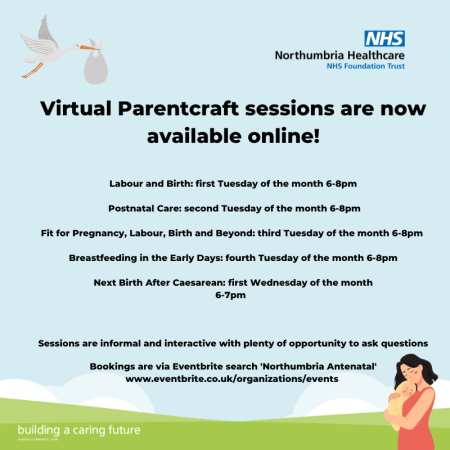
Our Parentcraft team have developed a programme of virtual antenatal education classes which you are welcome to attend via Zoom.
Book your place via Eventbrite here
Screening tests are used to find people at higher chance of a health condition. Whether or not to have each test is a personal choice that only the individual invited for screening can make.
We offer all pregnant women screening tests during pregnancy to look for certain health conditions that could affect them or their baby.
Screening tests are also offered for babies soon after they are born so they can be given appropriate treatment as quickly as possible if needed.
Read the screening tests for you and your baby leaflet before your midwife booking appointment to find out much more about the screening tests offered during and after pregnancy. This information is also available in other languages and easy guides.
If you need one, you can pick up a printed copy of this leaflet at your booking appointment.
Antenatal screening programmes:
- Sickle cell and thalassaemia
- Infectious diseases
- Down’s/Edward’s/Patau’s syndrome and fetal anomaly ultra sound scan
Newborn screening programmes:
- Hearing screening
- Blood spot screening
- Newborn and infant physical examination
The screening programmes will be discussed with you at the appropriate time, either during your pregnancy or after the birth of your baby. You will have time at your appointments to discuss your options and have any queries that you may have answered.
More information about these programmes are available in your ‘screening tests for you and your baby’ leaflet given to you at your early pregnancy session/booking appointment. You can find more information on screening on NHS Choices here.