

Publish date: 17 July 2026
How we help people stay at home and out of hospital
Context
The 10 Year Health Plan for England, published in summer 2025, focuses on 3 big shifts to how the NHS works.
The first shift is from hospital to community: more care will be available on people’s doorsteps and in their homes. The plan talks about the principle that ‘care should happen as locally as it can’ and ‘in a patient’s home if possible’.
Why?
The 10-year plan talks about how the NHS ‘is hospital centric, detached from communities and organises its care into multiple, fragmented siloes’. The alternative is the neighbourhood health service to bring care into communities.
There is also evidence that treating people at home ‘can be just as good – or even better – than hospital care’. You can read more about the study here.
Benefits include:
- Enhanced comfort and autonomy
- Faster recovery and mobility
- Easier for family and friends – reducing travel in a patch as large as ours across Northumberland and North Tyneside
- Better cognitive outcomes – for vulnerable patients, e.g., older patients who are at risk of delirium (acute confusion)
- Lower infection risk
We track the experiences of patients that we care for, and we get positive feedback from those we care for at home.
Here’s some comments from our Hospital at Home patients:
“They sorted out anything you needed, prescriptions, nebuliser, and talked you through it. You knew they were there at the end of the phone, and you knew they’d come back out and see you if they had to. I think I got better care at home, and I was more confident because I knew they were there.”
“When I was coming home in that hospital car, I felt at ease from there and everything was smooth and straightforward. All the care I got was top class and I couldn’t fault it at all.”
“The care was wonderful. I never expected that. The physio came every other day and put me through a set of exercises. All the equipment they thought I needed they supplied.”
Keeping patients out of our hospitals helps us keep our hospital beds free for those that need them.
By caring for people at home and responding to their needs, we hope to avoid people coming to our emergency department too. This again helps protect these services for those that really need them.
How we do it
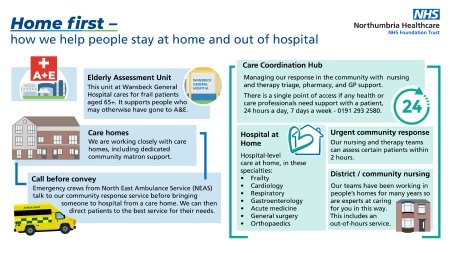
We are an acute and community trust. Our community teams have been working in people’s own homes for many years so are experts at caring for you in this way.
We have different services to help you avoid going into hospital or return home more quickly for further treatment following a hospital stay.
Many will be familiar with traditional district or community nursing. For decades, our district nurses have supported people in their own homes. This can be if you have a chronic or life-limiting condition, or you are housebound due to a serious bout of illness.
In recent years, we have added newer models of care. This includes Hospital at Home and 2-hour urgent community response.
Hospital at Home wards provide hospital-level care in the comfort of your own home.
Various healthcare professionals, including doctors, nurses, therapists and pharmacists, may visit you at your home. They may provide treatments, carry out tests and assessments, or check on your condition.
We keep in touch with patients via phone and online consultations too. In certain cases, we may give you special equipment so our teams can monitor you remotely.
We have cared for thousands of patients in our Hospital at Home wards in recent years. They cover these specialties:
- Frailty
- Cardiology
- Respiratory
- Gastroenterology
- Acute medicine
- General surgery
- Orthopaedics
Our urgent community response service means we can assess certain patients where they live within 2 hours.
Examples of this include:
- Suspected infections
- Frailty symptoms getting worse
- Confusion / delirium
- Falls
Supporting this is our care coordination hub which manages our response in the community. It covers nursing and therapy triage, pharmacy, and GP support.
We have a single point of access phone number if any health or care professionals need support with a patient, 24 hours a day, 7 days a week - 0191 293 2580.
In care homes
We also work closely with care homes to help care for their residents, with dedicated community matron support.
Our call before convey scheme, launched in November 2025, means emergency crews from North East Ambulance Service talk to us before bringing someone to hospital from a care home. We can then direct patients to the best service for their needs.
In community settings
When care where people live isn’t possible, we look to care for people in their communities.
For example, our Elderly Assessment Unit at Wansbeck General Hospital cares for frail patients aged 65+. It supports people who may otherwise have gone to the emergency department in Cramlington.
Helping people leave hospital
For those that do have a spell in hospital, we work in partnership with the local councils in Northumberland & North Tyneside in hospital discharge teams.
Home Safe (Northumberland) & Care Point (North Tyneside) are integrated health and social care services based in our hospitals, which support patients to get home.
The teams include social workers, social work support assistants, discharge nurses, physiotherapists, and occupational therapists. They work together to support your discharge once the medical team feel you are well enough to leave hospital.
Wherever possible, we provide support in people’s own homes. On some occasions, this is not possible, and you will need a short spell of personalised rehab in an inpatient unit.
We have 2 intermediate care units in Northumberland and North Tyneside. These help people recover from illness and injury while increasing their independence.
We have 2 other facilities in the rural areas of Northumberland.
Haltwhistle Community Hospital was rebuilt more than a decade ago in a scheme with Northumberland County Council. It was one of the first facilities of its kind in the country to provide hospital and social care support under one roof.
The team provides specialist support and rehabilitation for patients who need extra help to prepare them for going home.
Further north, in Rothbury, we launched a strategic partnership with Rothbury Cottage Care Ltd in early 2023.
It means we can provide a flexible number of beds to meet the needs of people in Rothbury, while continuing to deliver extra support for people’s health and care needs in their own home.
Rothbury Cottage Care Ltd runs a 14-bed unit for people needing respite care, rehabilitation services, longer-term recuperation, or end-of-life care.