

Publish date: 3 February 2026
"Cancer does not stop when treatment ends and neither should the understanding, patience, or support."- World Cancer Day 2026
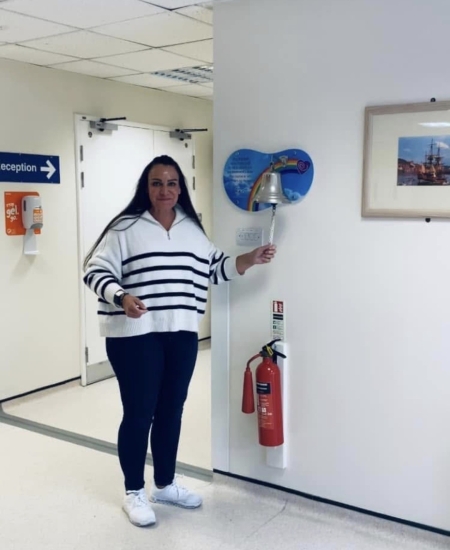
To mark World Cancer Day on 4 February, we are sharing an interview with Lindsay Holmes, an Operational Service Manager in Community Services, who reflects on her experience with cancer.
Can you tell us a little about your diagnosis and treatment journey?
I was diagnosed on 21 April 2023 with stage 2 lobular breast cancer. This was a diagnosis that arrived quietly, without the dramatic lump everyone expects. My only symptom was soreness and a persistent gut instinct that something wasn’t right. That instinct turned out to be the most important part of the journey.
What followed was a familiar routine for many cancer patients: scans, mammograms, biopsies, waiting rooms, and learning how much of life is spent waiting for results. I went on to have a lumpectomy and sentinel lymph node biopsy, followed by radiotherapy, and the start of five years of hormone therapy (tamoxifen).
On paper, that sounds neat and contained. It involved radioactive dye, surgical gowns, CT scanners, free tattoos, and a lot of adjustment. I also learned quickly that being small in the breast department has its own challenges in radiotherapy positioning. I spent a fair amount of time apologising for not quite fitting where I was supposed to and compensating by cracking jokes. Making the radiographers laugh became part of my coping strategy — if you can’t control the machine, you can at least control the atmosphere.
Being told “we got it all” was the best possible outcome but it wasn’t the end. Treatment finishes; the impact doesn’t. Side effects, fatigue, hormonal changes, ongoing scans, work pressures, and family life all continue alongside recovery.
What has surprised you the most about living with cancer?
I was surprised by how resilient I became. Not in an inspirational-poster way, but in a very practical, stubborn sense. I painted rooms while nauseous, negotiated gym access like it was a competitive sport, and celebrated small wins like not throwing up in Aldi.
I was also surprised by how life must keep moving, whether you feel ready or not. One of the things that helped most was keeping clear boundaries: hospital appointments were hospital appointments, but home was still home. Family life didn’t stop, and in many ways that normality kept me grounded.
My mum and dad were with me every step of the way, driving me to appointments, sitting in waiting rooms, turning up consistently and quietly, without ever making it feel overwhelming. Their support allowed me to keep some emotional separation between cancer and home, which was more important than I realised at the time.
You've done lots of amazing things during your cancer journey. What are some of the moments or achievements you've enjoyed the most?
Without doubt, writing the weekly “Friday Feels” blogs.
They started as a way to keep people informed but became a way of staying sane. Each week I deliberately searched for the positives, sometimes big (clear margins, finishing radiotherapy, ringing the bell), sometimes tiny (not burning the tea, surviving a hospital playlist, or being told I could get back on my bike).
Alongside the writing, I wanted to turn the experience into something that gave back. That led to raising money and setting physical challenges, including climbing mountains, which gave me focus, purpose, and a sense that my body (despite everything) was still capable of strong, meaningful things.
Out of the blogs grew the start of a funny, observational book. Not a tragic cancer memoir, but an honest account of the admin, the absurdity, the body changes, the dark humour, and the reality that cancer doesn’t take away your personality unless you let it.
What kind of support made the biggest difference to you during this time?
Support came in many forms, but consistency mattered most.
Clinically, the NHS teams and Macmillan nurses were exceptional. Not just for their expertise, but for their kindness and humanity. Being listened to and treated as a whole person made an enormous difference.
At home, my partner’s support was unwavering. One of the hardest moments was missing the Isle of Man TT, something we go to every year and something that means a huge amount to us. Surgery meant I couldn’t go, and that loss hit harder than I expected. My partner never once made it feel like a disappointment, just another thing we’d return to when I was ready.
My parents, children, friends, and wider family provided practical help, emotional steadiness, and laughter, often when I needed it most but didn’t realise it.
For colleagues, patients, or anyone affected by cancer, what message would you like to share this World Cancer Day?
Cancer does not stop when treatment ends and neither should the understanding, patience, or support.
Recovery isn’t linear. You don’t “go back to normal”. You build a new normal that includes medication, fatigue, scans, fear of recurrence, work pressures, and family life continuing all at once.
Find moments of peace where you can. For me, that came kayaking in Scotland, quiet water, fresh air, and the reminder that life can still feel calm and expansive, even after everything.
Laugh when you can. Joke with the radiographers. Swear at the machines if needed. Climb mountains. Write things down. Keep living.
And please check, check, check. Trust your instincts. Feel your boobs. Feel your balls. Go to the GP. Early diagnosis changes outcomes.
Cancer may take up space, but it doesn’t get to define you…unless you let it.